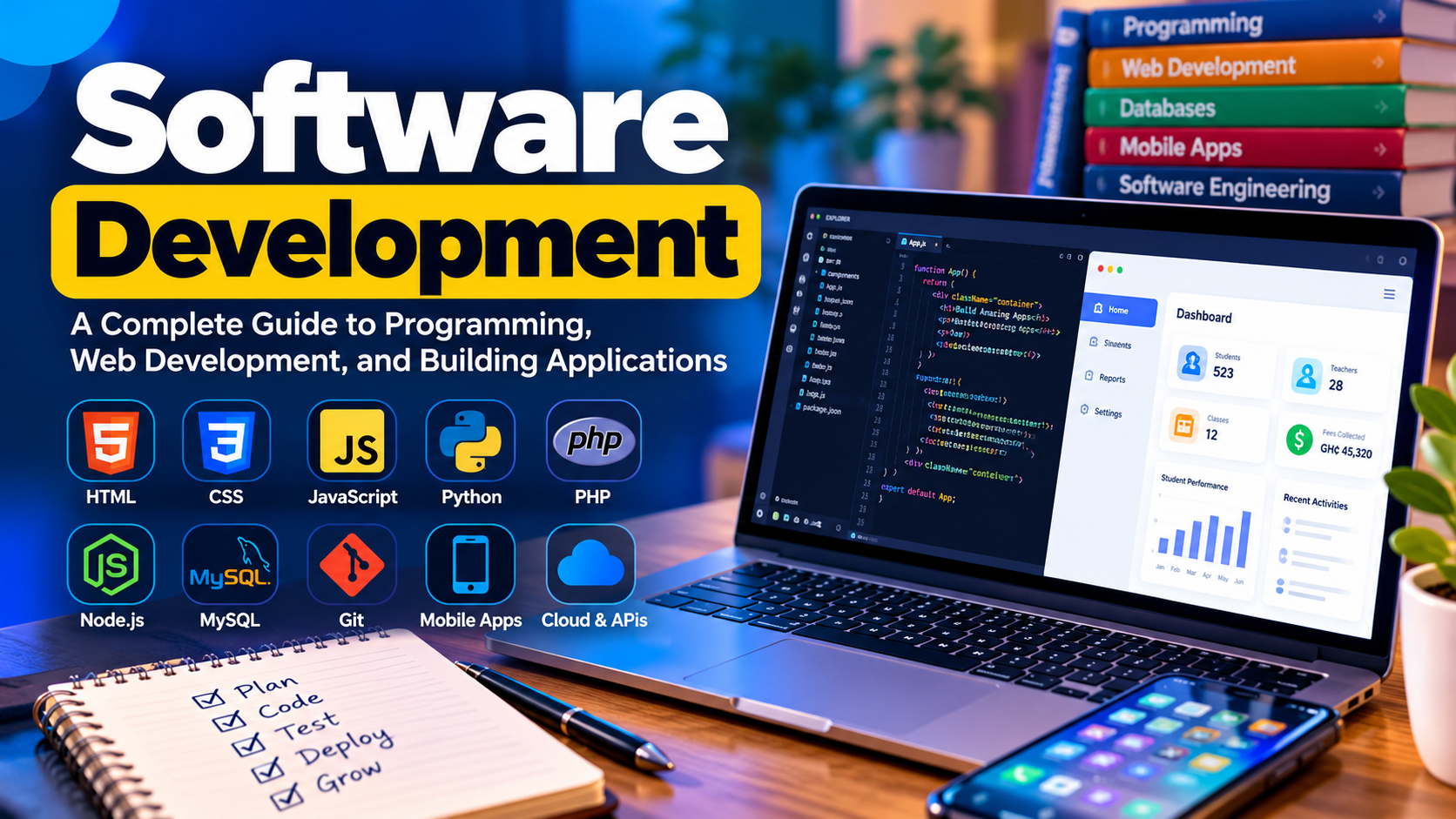
Software Development: A Complete Guide to Programming, Web Development, and Building Applications
Introduction
Software development is one of the most valuable skills in today's digital world. From mobile applications and websites to business management systems and educational platforms, software plays an important role in how individuals, businesses, and organizations operate.
Whether you are a beginner interested in learning programming or an entrepreneur looking to develop software for your business, understanding the fundamentals of software development can open up many opportunities.
In this article, we will explore what software development is, the different types of software development, the programming languages you can learn, and how to get started.
What Is Software Development?
Software development is the process of designing, creating, testing, deploying, and maintaining computer programs and applications to solve specific problems.
Developers use programming languages, frameworks, databases, and development tools to build software that performs particular tasks.
Examples of software applications include:
- School management systems
- Point of Sale (POS) applications
- Inventory management systems
- Websites and web applications
- Mobile applications
- Banking and financial applications
- Payroll management systems
- Educational technology platforms
Software development can be used to automate business processes, improve productivity, manage information, and provide digital services to users.
Types of Software Development
There are several areas of software development, and each focuses on building different types of applications.
1. Web Development
Web development involves creating websites and web applications that users access through internet browsers.
Examples include business websites, online stores, school portals, blogging platforms, and online learning systems.
The main technologies used in web development include:
- HTML for structuring web pages
- CSS for styling and page layouts
- JavaScript for interactive features
- PHP, Python, or Node.js for backend development
- MySQL and PostgreSQL for database management
Web development is a popular starting point for beginners because many learning resources and development tools are available online.
2. Desktop Application Development
Desktop application development involves creating software that runs on computers, including Windows, macOS, and Linux systems.
Examples include accounting software, inventory management systems, school management applications, and office productivity tools.
Popular technologies include Python, C#, Java, C++, and Visual Basic for Applications (VBA).
Desktop applications are useful for businesses that need specialized software to manage their daily operations.
3. Mobile Application Development
Mobile app development focuses on creating applications for smartphones and tablets.
Examples include mobile banking applications, educational apps, communication platforms, and e-commerce applications.
Developers can use technologies such as Kotlin for Android, Swift for iOS, Flutter, and React Native to build mobile applications.
4. Enterprise Software Development
Enterprise software development involves building applications that help organizations manage complex business operations.
Examples include Enterprise Resource Planning (ERP) systems, Customer Relationship Management (CRM) platforms, Human Resource Management Systems, and school management systems.
These applications often combine databases, user authentication, reporting, automation, and integrations with other services.
5. Artificial Intelligence Software Development
Artificial intelligence development involves creating applications that can perform tasks such as generating content, analyzing data, recognizing patterns, and assisting users with decision-making.
Examples include AI chatbots, lesson plan generators, document analysis tools, and intelligent recommendation systems.
Developers commonly use Python and AI APIs to build these solutions.
Best Programming Languages to Learn
Choosing a programming language depends on the type of software you want to develop.
Here are some popular options:
Python: A beginner-friendly language used for automation, artificial intelligence, data analysis, and backend development.
JavaScript: An essential language for interactive websites and widely used in full-stack web development.
PHP: A popular language for building dynamic websites and backend systems.
Java: Used for enterprise applications, backend services, and Android development.
C#: Commonly used for Windows applications, enterprise software, and game development.
C++: Suitable for performance-intensive applications, system programming, and game engines.
SQL: A language used to store, retrieve, and manage data in relational databases.
You do not need to learn all these languages at once. Start with one that aligns with your goals and gradually expand your skills.
Essential Tools for Software Developers
Software developers use various tools throughout the development process.
Some essential tools include:
- Visual Studio Code: A code editor for writing and managing source code.
- Git and GitHub: Tools for version control, collaboration, and managing code repositories.
- Node.js: A JavaScript runtime used for backend development and development tooling.
- MySQL: A relational database management system.
- Postman: A tool for testing APIs.
- Docker: A platform for packaging applications and their dependencies.
- GitHub Copilot and AI coding assistants: Tools that can help developers understand code, generate suggestions, and troubleshoot problems.
The tools you need will depend on your chosen programming language and project requirements.
Steps to Become a Software Developer
If you want to become a software developer, follow these practical steps.
Step 1: Choose Your Area of Interest
Decide whether you want to develop websites, desktop applications, mobile apps, business systems, or AI-powered solutions.
Having a clear direction will help you choose the right technologies.
Step 2: Learn the Fundamentals of Programming
Start with basic concepts such as variables, data types, operators, conditional statements, loops, functions, and error handling.
These concepts form the foundation of most programming languages.
Step 3: Build Small Projects
Practice by creating simple projects, such as a calculator, student registration form, expense tracker, or personal website.
Practical projects help you understand how programming concepts work in real situations.
Step 4: Learn Databases and APIs
Most modern applications need to store information and communicate with other systems.
Learn how databases work, how to perform CRUD operations (Create, Read, Update, and Delete), and how APIs allow different applications to exchange information.
Step 5: Develop Real-World Applications
Once you understand the basics, work on more advanced projects such as a school management system, inventory application, online booking platform, or business dashboard.
Start with a manageable set of features and improve your application gradually.
Step 6: Learn Testing, Security, and Deployment
Writing code is only one part of software development.
You must also learn how to test applications, protect user information, manage errors, deploy software, and maintain applications after release.
Step 7: Build a Portfolio
Create a portfolio that showcases your completed projects, the technologies you used, and the problems your applications solve.
A strong portfolio can help you attract clients, apply for jobs, or promote your own software products.
The Role of Artificial Intelligence in Software Development
Artificial intelligence is changing how software developers plan, write, test, and maintain applications.
AI coding assistants can help explain unfamiliar code, suggest improvements, generate test cases, identify possible errors, and speed up repetitive tasks.
However, AI-generated code still requires careful review. Developers must understand the code, verify its correctness, test its security, and ensure that it meets the project's requirements.
The most effective approach is to combine AI tools with strong programming fundamentals and practical problem-solving skills.
Career Opportunities in Software Development
Software development offers several career and business opportunities, including:
- Software developer
- Web developer
- Mobile app developer
- Backend developer
- Full-stack developer
- Database developer
- Software testing engineer
- AI application developer
- Freelance software consultant
- Software entrepreneur
You can work for technology companies, government institutions, educational organizations, financial institutions, or start your own software development business.
You can also create and sell software products to customers who need solutions to specific problems.
Conclusion
Software development is a valuable skill that combines creativity, logical thinking, and problem-solving. It allows you to transform ideas into practical digital solutions for individuals, businesses, schools, and organizations.
Whether you are interested in web development, desktop applications, mobile apps, or artificial intelligence, the best way to begin is to choose a learning path, practice consistently, and build real projects.
With dedication and continuous learning, you can develop the skills needed to create useful applications and explore opportunities in the technology industry.
Ready to start your software development journey? Choose a programming language, build your first project, and continue improving your skills through practical experience.
Keep learning, keep building, and turn your ideas into software solutions.
Kind words
No approved comments yet.